Ask five anglers to name the best bass fishing lures and you’ll get five different tackle boxes worth of answers, and honestly, all five might be right for their water. What actually separates a good buying decision from a wasted one isn’t finding some universal best bait, it’s understanding which categories of lures cover the situations you’ll actually fish and building outward from there.
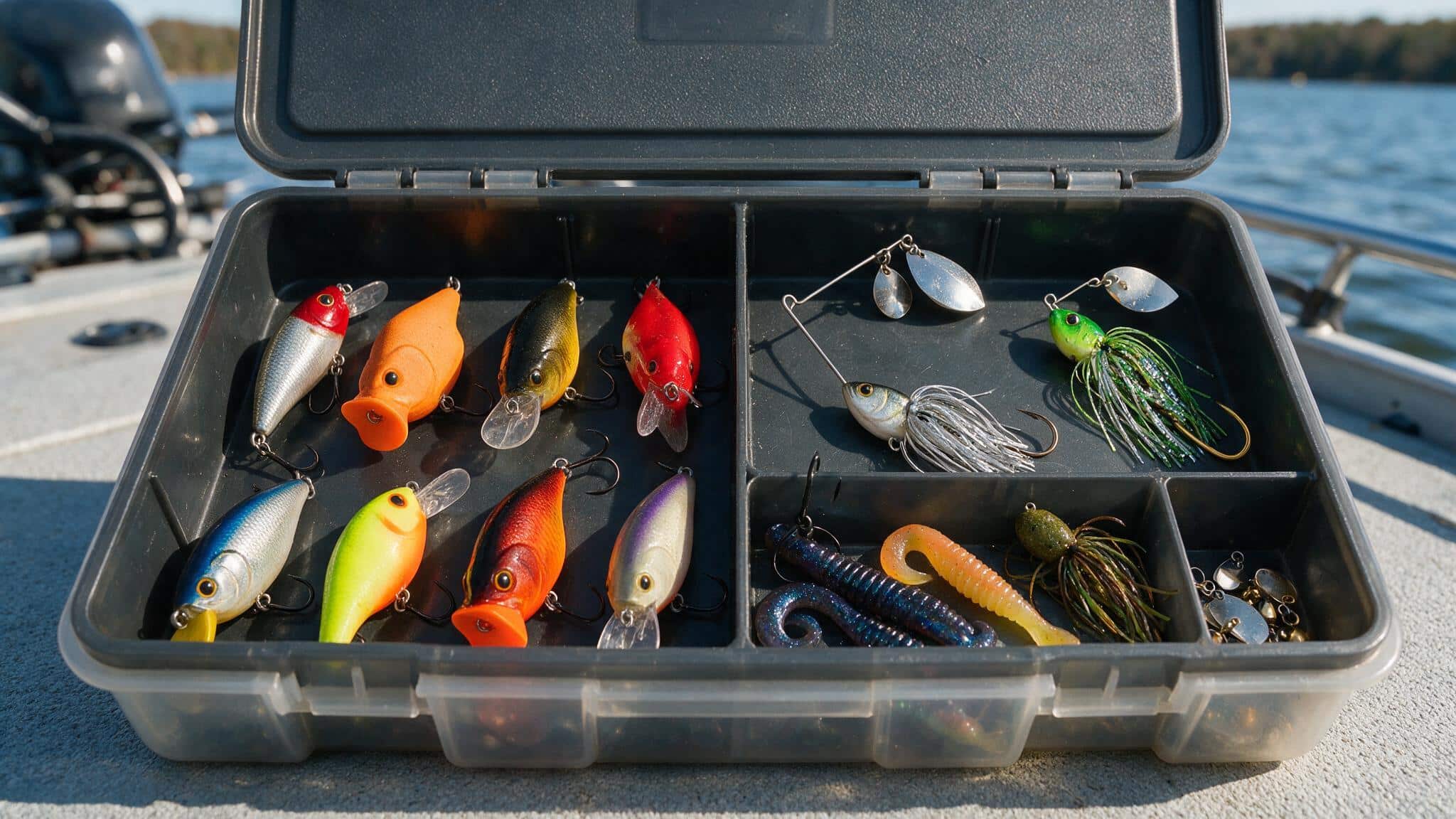
I spent my first couple seasons buying whatever got hyped in forums and videos, and ended up with a tackle box full of lures I’d thrown twice. Once I started thinking about lure categories instead of individual products, my results improved and my spending dropped at the same time. That’s the approach behind this guide to the best bass fishing lures worth owning.
crankbaits: the search bait
A crankbait dives on a bill, wobbles through the retrieve, and covers water faster than almost anything else in a bass angler’s box. Squarebills work shallow cover and deflect off wood and rock without hanging up as often as their profile suggests. Deep divers earn their keep on offshore structure, ledges, and points once you know how to find that kind of water. A crankbait’s real value is efficiency: it lets you eliminate unproductive water fast, which matters more on new lakes than on water you already know well.
spinnerbaits and chatterbaits: vibration and flash
Spinnerbaits and chatterbaits both use a metal blade to throw flash and vibration, but they behave differently enough to justify owning both. A spinnerbait’s open wire frame comes through grass and brush cleaner, making it the better choice in scattered cover. A chatterbait’s blade sits fixed against the jig head, putting off a tighter thump that shines in stained water and matted vegetation. If you only own one of the two, a chatterbait covers slightly more situations for most largemouth water, and our complete guide to chatterbait fishing goes deep on how to fish one properly.
soft plastics: the most versatile category
Texas-rigged worms and creature baits fish weedless through heavy cover, and nothing in a tackle box catches a wider range of conditions and fish sizes. A shaky head or wacky-rigged worm handles finesse situations when bass get finicky, and a Carolina rig covers open bottom where fish are scattered and hard to pattern precisely. If you’re building a box from scratch and can only fill one section first, fill the soft plastics section. It’s the category that saves the most days when nothing reactive is working, and pairing a few soft plastics with the lighter presentations covered in our finesse lures guide rounds out the finesse side of the box fast.
jigs: the big fish bait
A flipping jig with a beefy trailer catches the biggest bass in a lake more consistently than almost anything else once fish lock onto heavy cover. It’s not a search bait, it’s a bait you fish slowly and deliberately around visible targets: laydowns, dock posts, matted grass, isolated stumps. A jig demands more patience than a crankbait or spinnerbait, and it rewards anglers willing to fish one target thoroughly instead of moving on after two casts.
topwater: situational but unforgettable
Topwater baits are the most situational entry on any list of the best bass fishing lures, mostly productive during low-light windows in warm water, but the strikes are some of the most exciting in the sport. A walking bait like a classic prop-style stickbait covers open water searching for cruising fish, while a hollow-body frog earns its keep over matted grass and lily pads where nothing else gets a fair shot. I don’t reach for topwater as often as the other categories here, but the mornings when it’s on are hard to beat.
swimbaits: skip them early
Big soft swimbaits and glide baits get a lot of attention online, and they do catch giant bass in the right conditions. For most weekend anglers building a first box, though, they’re a low priority. They’re expensive, they demand heavier gear than most people already own, and they produce far fewer bites per hour than any category above. I own a few and use them a handful of times a year on specific lakes with a known population of larger fish. They’re worth adding once the core rotation above is covered, not before.
what actually belongs in a beginner’s box
If I were rebuilding a box from zero, I’d start with a handful of soft plastic worms in green pumpkin and black and blue, a chatterbait or two, a squarebill crankbait, a flipping jig, and a spinnerbait for scattered cover. That short list covers the majority of situations most weekend anglers run into on ponds, reservoirs, and natural lakes, and it costs a fraction of what a fully stocked box runs. Pair it with the rods and reels covered in our bass fishing gear guide, and you have a complete, functional setup without chasing every new release that shows up online.
mistakes anglers make buying bass lures
Buying every color a lure comes in wastes more money than any other mistake I see. Two or three color patterns per lure category, one natural and one for stained water, cover almost every situation. Chasing hyped new releases before mastering a smaller core rotation is the second common mistake. A confident angler fishing five lures well will out-catch someone constantly switching between the newest releases without ever learning how each one actually behaves in the water.
The other mistake is treating lure choice as more important than presentation and location. The best bass fishing lures in the world won’t produce fish sitting in the wrong depth or the wrong water temperature range. Lure selection matters, but it’s the last variable to adjust, not the first.
building a box that actually fishes
None of the categories above replace each other completely, and that’s the point. A crankbait finds active fish fast, a jig grinds out quality bites in heavy cover, soft plastics salvage tough days, and a chatterbait or spinnerbait splits the difference between reaction bait and finesse presentation depending on conditions. Understanding what each category is actually built to do, rather than chasing whatever produced a viral catch video last week, is what turns a random collection of tackle into the best bass fishing lures for the water you actually fish. Learn the fundamentals covered in our complete bass fishing guide, match your box to your local water, and let the lures earn their spot through results instead of hype.