Jig fishing for bass is the technique most serious tournament anglers reach for when they need one bait to catch a giant instead of a limit of dinks, and it remains one of the most underused baits among casual anglers who find it slow next to a chatterbait or crankbait. A jig doesn’t cover water fast and it doesn’t have flash built in, but it catches the biggest fish in the lake more consistently than almost anything else you can tie on. Here’s what makes jig fishing for bass worth the patience it demands.
why a jig catches the biggest bass in the lake
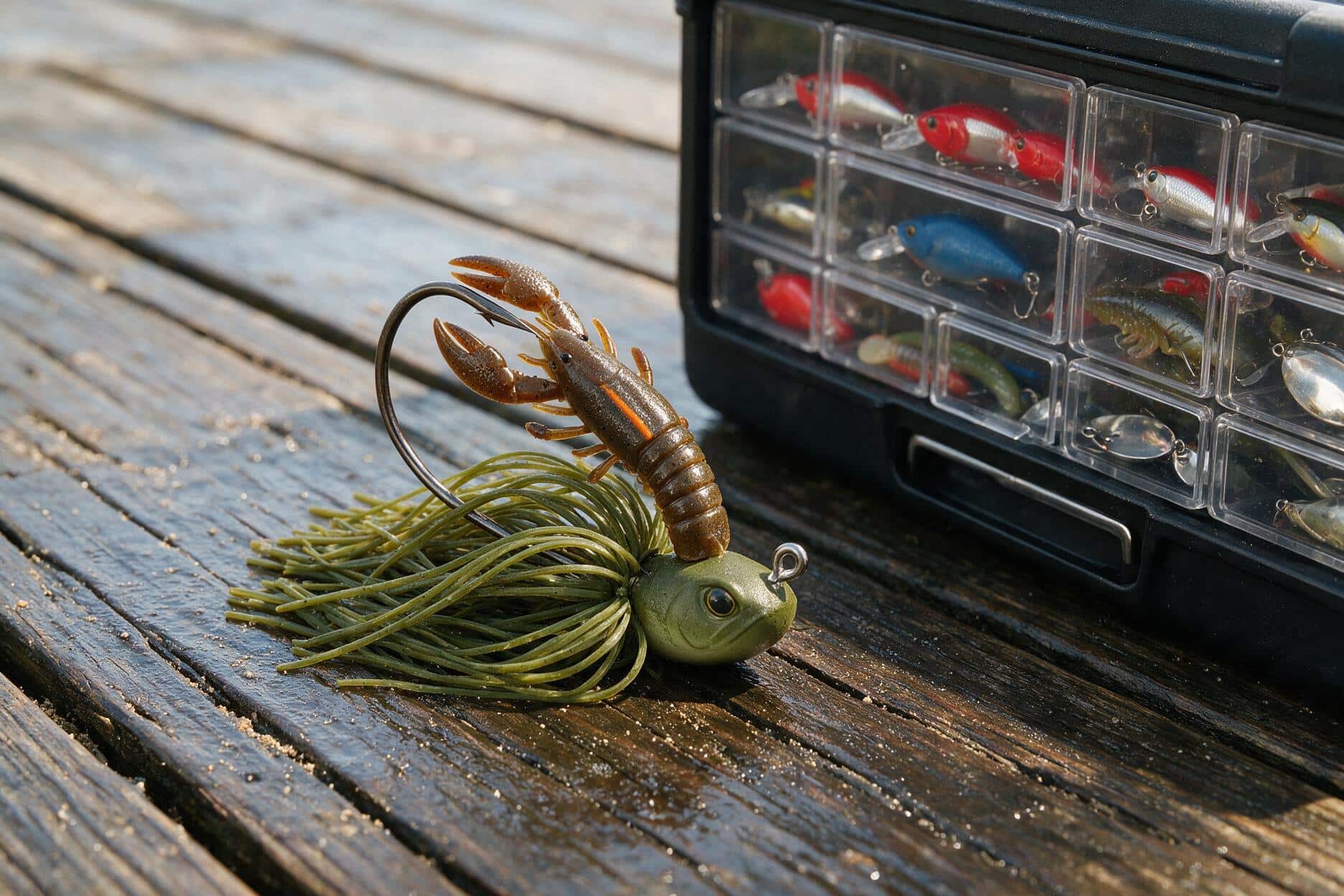
A jig looks like nothing specific and everything a bass has learned to eat: a craw, a bluegill, a dying baitfish, depending on how it’s dressed and moved. The head is weighted to keep the hook point up, so the bait moves through cover with fewer hangups than you’d expect from an exposed hook. Big bass, the four, five, six pound fish many anglers never catch on a spinnerbait or crankbait, key on jigs because the bait mimics a full meal rather than a quick reaction target. A mature bass that has seen thousands of casts is often more willing to eat something that looks like real food moving slowly than something flashing past.
the jig styles worth owning
A flipping jig has a compact, heavy head built to punch through matted grass, brush piles, and dock cover, paired with a stiff weed guard that keeps the hook clean until a fish closes its mouth on it. This is the bait most anglers mean when they talk about jig fishing for bass around heavy cover, and it’s one of the most reliable ways to pull a giant largemouth out of nasty cover.
A football jig has a rounded head shaped to stand the bait upright and crawl smoothly over rock, gravel, and hard bottom without constantly hanging up, which makes it the right choice for offshore structure and deep, clear reservoirs where fish relate to bottom composition rather than visible cover.
A swim jig is built with a bullet-shaped head and a lighter wire hook, designed to be retrieved steadily through grass and around cover instead of dragged or hopped along bottom. It behaves like a spinnerbait without the blade, and it shines in stained water with scattered vegetation.
A finesse jig, smaller and lighter than the other three, works in clear water and heavy fishing pressure, when bass have seen every big, bulky bait in the box and want something subtler.
trailers make or break the bait
The trailer, a soft plastic craw, creature bait, or grub threaded onto the jig’s hook, changes the fall rate, the profile, and the action more than most anglers give it credit for. A bulky, high-action craw trailer slows the fall and adds movement, which suits cold water or a slower presentation. A slim, low-action trailer drops faster and looks more subtle, which fits aggressive fish or a faster presentation in warmer water. Matching trailer color to water clarity follows the same logic as everything else in bass fishing: natural browns and greens in clear water, black and blue or darker colors that show a strong silhouette in stained water.
where and when to fish a jig
Jigs excel around heavy cover: laydowns, brush piles, dock pilings, and matted grass, especially once summer pushes bass tight against shade and structure. They also shine on offshore structure in summer and fall, when a football jig crawled across a hump or ledge matches the bottom contour a school of bass is relating to. Cold water is jig season above almost anything else. When water drops into the 40s and low 50s, a jig fished painfully slow, sometimes barely moving for ten or fifteen seconds at a time, out-produces nearly every other bait in the box, because a lethargic bass simply will not chase anything moving fast.
how to actually fish it
Pitching and flipping puts the jig into precise targets, docks, laydowns, isolated bushes, with almost no splash to spook nearby fish. Let it fall on a controlled line and watch for any twitch, jump, or change in the fall, since a bass eating a jig on the drop rarely announces itself with a hard thump. Dragging works a football jig slowly along bottom, keeping constant contact and pausing over any change in bottom composition, a rock, a shell bed, a hard-to-soft transition. Hopping lifts the jig off bottom a foot or two and lets it fall back, which triggers reaction strikes from bass that ignore a straight drag. A swim jig just gets reeled steadily, with an occasional pause through gaps in cover to let it flutter down.
gear that makes jig fishing for bass easier
A medium-heavy to heavy fast-action casting rod, 7 feet or a touch longer, gives you the backbone to horse a big fish out of cover and enough tip sensitivity to feel a subtle pickup. Braided line in heavy cover, 40 to 65 pound, cuts through grass and stops a fish before it wraps you around wood. In open, clearer water, 15 to 20 pound fluorocarbon presents more naturally and still handles most fish. A reel in the 7.1:1 to 8.1:1 range helps you take up slack fast on a pitch or a hookset from thirty feet away.
the mistakes that cost the most fish
Fishing a jig too fast is the same mistake anglers make with nearly every other bait, and it costs more here since the whole appeal is a slow, natural fall. Trimming the skirt too aggressively, or leaving it too bulky for the water clarity, throws off the profile fish key on. And missing bites on the fall is the biggest one: most strikes happen as the jig sinks, not after it lands, so watching your line rather than waiting to feel a thump will put more fish in the boat than any piece of tackle you could buy.
If you already fish soft plastics around the same cover, our complete guide to soft plastic baits covers trailer selection and rigging in more depth, since a jig trailer is really just a soft plastic doing a different job. For the full lineup of bass lures and when each one earns a cast, see our complete guide to bass fishing lures, and the complete guide to bass fishing covers the seasonal movement and structure reading that make jig placement make sense in the first place.
put it together on the water
Jig fishing for bass rewards patience over speed. Pick the head style that matches your cover, match the trailer to water clarity and temperature, and fish it slower than feels natural, especially in cold water. It will not put the most bites in your day, but it consistently accounts for the biggest bass in the livewell.