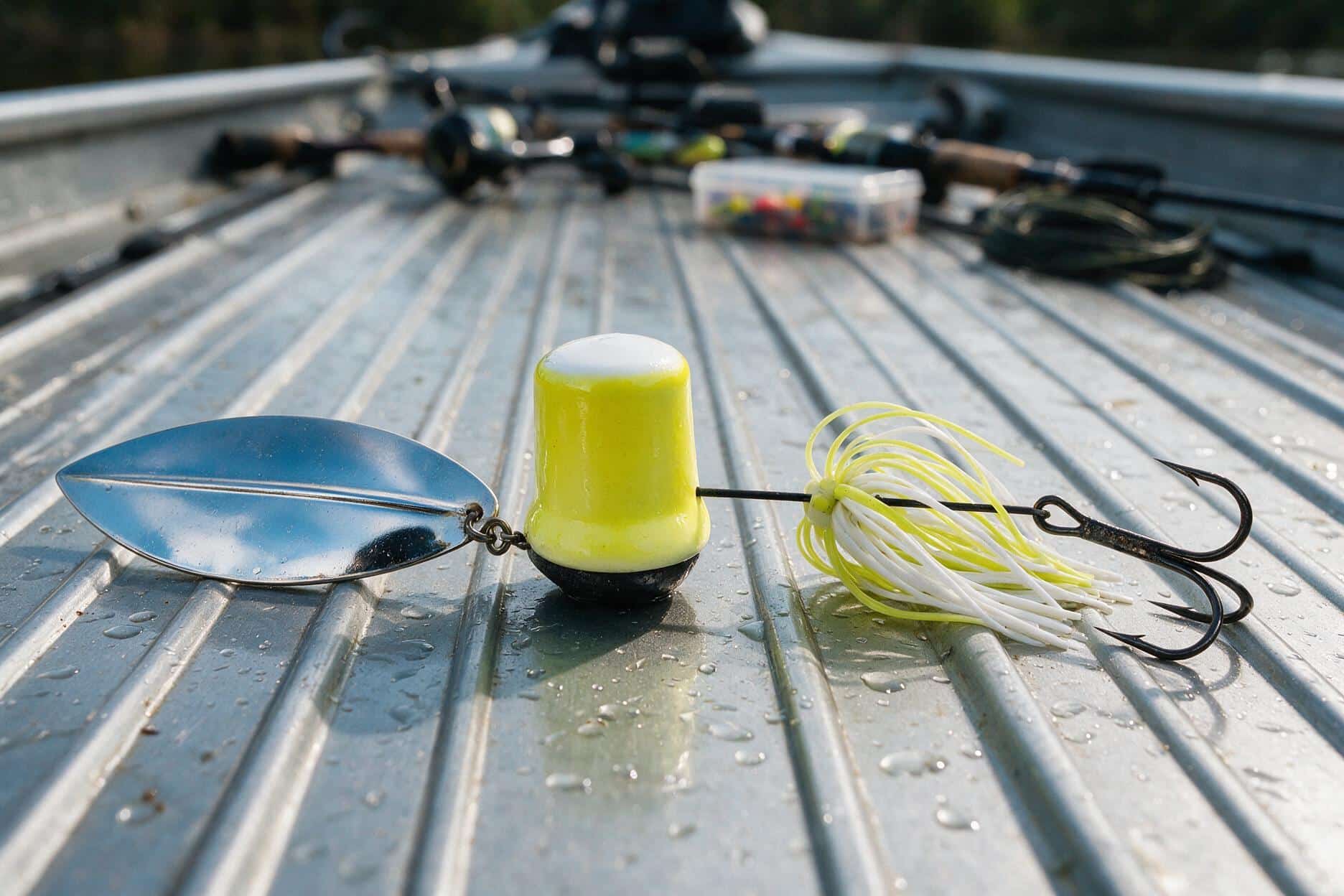
A spinnerbait is a bent-wire lure with a lead head and hook on one arm and one or two spinning blades on the other, built to flash and thump through the water like nothing and everything a bass wants to eat at once. A good spinnerbait for bass fishing covers water fast, works in water most other lures can’t, and still gets overlooked by anglers who assume it’s an old-fashioned bait. Here’s when a spinnerbait for bass fishing actually earns a spot on the deck, and when you’re better off tying on something else.
what a spinnerbait actually is
A spinnerbait has three main parts: the head, the skirt, and the blades. The lead head carries a single hook molded right into it, so unlike a crankbait or jerkbait covered in trebles, a spinnerbait has one point to worry about, which is a big part of why it comes through wood, rock, and grass without hanging up every third cast. A silicone or living rubber skirt covers the hook and adds bulk and pulse in the water. Above that, a wire arm holds one or two blades that spin as the bait moves, throwing flash and vibration that a bass can pick up through its lateral line before it ever sees the bait.
That matters more than most anglers realize. A spinnerbait for bass fishing works in water where sight-based lures fall apart, because the fish doesn’t need to see it clearly to find it.
when to tie one on
Stained water is the classic call for a spinnerbait. Anything from light tea color to chocolate milk, and a spinnerbait’s flash and thump give bass a target they can find without needing clear sightlines. Overcast days extend that same logic into clearer water, since low light makes fish more willing to chase and less likely to get a good long look before committing.
Wind helps too. A breeze chopping up a bank or blowing into a point disorients baitfish, and a spinnerbait fished through that same wind-blown cover imitates the shad and bluegill getting knocked around by the chop. I’ll throw a spinnerbait for bass fishing on any bank with active current or wind before reaching for something slower, since it covers so much water while I’m figuring out where the fish are actually sitting.
Spring and fall both produce good stretches for this bait, when bass are shallow and aggressive, cruising banks looking for an easy meal rather than holding tight to one piece of cover the way they do in the dead of summer heat.
blade styles and what they change
Colorado blades are round and cupped, and they thump hard even at a slow retrieve. That makes them the right call in muddy water or when you want to slow-roll a bait deep along a bottom contour. Willow leaf blades are long, narrow, and built for flash rather than thump. They come through grass more cleanly and suit a faster retrieve in clearer water, where a bass is reacting to a flicker of light more than a vibration it feels first.
Tandem blade setups, usually a smaller Colorado or Indiana blade up front and a willow trailing behind, split the difference and give you both flash and thump in one bait. Double willow rigs lean hard into a clean, fast, flashy presentation and are a common choice for smallmouth on rock and current.
how to retrieve it
The default retrieve is a steady, medium-speed crank right under the surface, letting the blades do the work without extra rod action. That alone catches fish, but three variations are worth learning. Slow-rolling means fishing the bait deep and slow, almost bumping bottom or ticking the tops of submerged grass, which works when fish are holding lower in the water column than a standard retrieve reaches. Bulging or waking runs the bait just under the surface fast enough to create a wake without breaking through, which draws vicious strikes from aggressive fish in warmer months. Yo-yoing, lifting the rod tip and letting the bait fall on a controlled semi-slack line back through cover, triggers reaction strikes from bass sitting tight against wood or dock pilings that ignore a straight retrieve entirely.
gear that matches the bait
A medium-heavy, fast-action casting rod in the 6’6" to 7’6" range handles most spinnerbait work, though I like a rod with a touch of parabolic give in the tip, since the single hook on a spinnerbait needs a hookset that won’t rip free the way a stiff blank can. A reel in the 6.3:1 to 7.1:1 range covers a fast retrieve for bulging and a slower presentation for rolling deep without switching reels.
Fifteen to twenty pound fluorocarbon or mono handles open water and moderate cover fine. Once you’re fishing a spinnerbait for bass fishing through matted grass or heavy wood, braid in the 40 to 50 pound range gives you the strength to horse a fish out before it wraps around something solid.
what actually goes wrong
Fishing it too fast is the most common mistake, especially in cold water where bass simply won’t chase down a bait moving at a summer pace. Slow the retrieve until you feel the blades thumping at a controlled tempo rather than buzzing through the cast. Skipping the trailer hook is another one. A short-shank trailer hook clipped to the main hook picks up short strikers, the bass that swipe at the blade or skirt without ever getting the main hook in their mouth, and it costs almost nothing in extra hang-ups.
Fishing the same blade color and style regardless of water clarity also leaves bites on the table. Gold and copper blades in stained water, nickel or silver in clear water, is a reasonable starting rule, and it’s worth switching before you assume the fish just aren’t there.
For a broader look at how spinnerbaits fit alongside crankbaits, jigs, and soft plastics, our complete guide to bass fishing lures breaks down the full lineup. If a spinnerbait isn’t drawing strikes in that same stained, windy water, a chatterbait is usually the next bait I tie on, since its bladed vibration works on a similar principle with a different action. And if you’re still building out the basics of bass behavior and seasonal movement, the complete guide to bass fishing is the place to start.
the short version
A spinnerbait for bass fishing earns its spot for one reason: it lets a bass find the bait without needing to see it well, which makes it the right choice in stained water, low light, and wind. Match the blade to water clarity, slow down in the cold, add a trailer hook, and fish it with confidence through cover most anglers avoid. That combination puts more fish in the boat than switching lures every ten casts ever will.