I have caught more fish standing on dirt and rock than I ever have from a boat, and I own a boat. That is not a brag, it is just math: shore access is free, and half the water near my house does not have a ramp within twenty miles anyway. Shore fishing is not the consolation prize for anglers without a boat. For a lot of species and water, it is the better option.
what shore fishing actually means
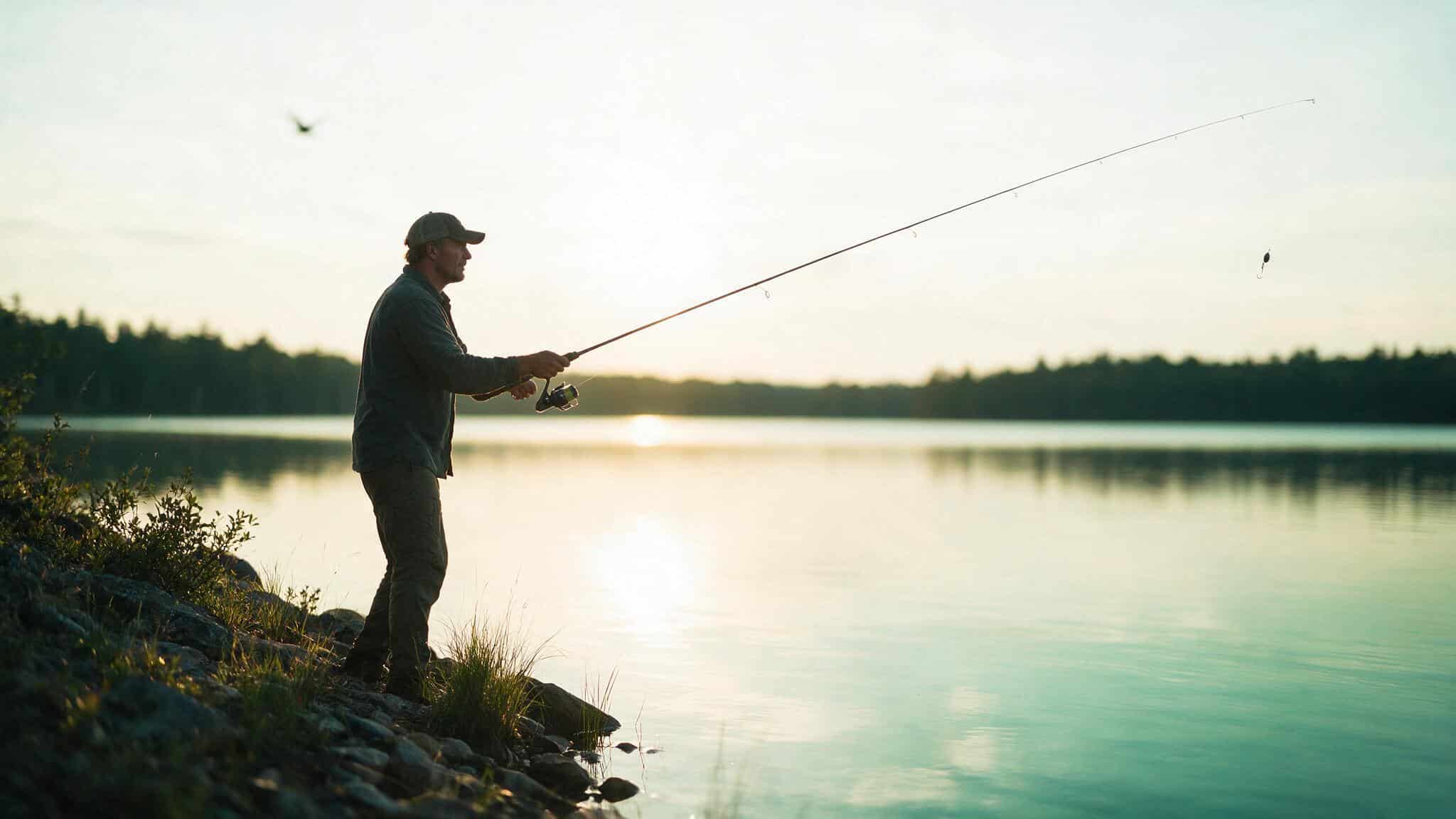
Shore fishing is any fishing done while standing on the bank, a beach, rocks, or a built structure like a dock or seawall, without a boat putting you over the water. That covers a wide range of conditions: a farm pond, a reservoir bank, a rocky river edge, a stretch of open coastline. Gear and tactics shift depending on which of those you are standing on, but the core limitation stays the same. You can only fish the water your cast and your feet can reach, so positioning matters more here than it does from a boat that can chase fish around. Our closer look at bank fishing walks through that positioning problem in more depth.
gear that earns its place in a shore setup
You do not need much to start shore fishing, and buying too much gear before you know what you are targeting is the fastest way to talk yourself out of the hobby. A medium spinning combo in the 6.5 to 7 foot range covers most freshwater shore situations, from bass to catfish to panfish, without needing to be swapped out every trip. Carry a small tackle bag instead of a full box since everything travels on your back, not in a boat compartment. Pliers, a net with a handle long enough to reach water you cannot wade into, and polarized sunglasses round out what actually gets used on a typical outing. Waders extend your range on cold water, but they are a second-season purchase, not day one.
reading the water without a boat
From a boat you can idle over structure and watch it show up on electronics. From shore you are reading the water with your eyes and your sense of how the bank probably looks underwater, a slower skill to build. Look for anything that breaks up a uniform bank: a point that juts out, a laydown tree, a rock pile, a channel swing that brings deep water close in. Wind blowing into a bank pushes baitfish and warmer surface water against it, and I have caught more fish off a wind-blown point than off any other single shore pattern. A flat, featureless stretch of bank is usually flat, featureless fishing too, so walk past it instead of grinding it out.
rigs and casting distance
Distance matters more in shore fishing than boat fishing, because you often cannot follow up a short cast by repositioning a boat six feet closer. A basic Carolina rig or a simple slip sinker setup casts further than most other options and covers unfamiliar bank water efficiently while you work out where the fish actually are. Our guide to fishing rigs breaks down which setup fits which situation, but as a starting rule: heavier weight and a stiffer rod buy distance, lighter weight and more finesse buy a subtler presentation once you have found fish nearby.
how to find a shore fishing spot near you
This is the question I get asked more than any other, usually some version of "where can I actually fish near me without trespassing." Start with your state wildlife agency’s website, most publish interactive maps of public fishing access points, wildlife management areas, and boat ramps that double as bank access even without launching anything. City and county parks departments are the second stop, since a lot of urban ponds and reservoir edges sit inside public parkland with open bank access during daylight hours. Whatever spot you land on, check the specific regulations before you fish it. Some public water requires a separate access permit beyond your fishing license, some stretches are catch-and-release only, and private land bordering public water is not fair game just because you can see the water from a public bank. A five-minute check of your state’s regulations page saves you a conversation with a game warden you do not want to have.
tides, current, and time of day
Freshwater shore fishing runs on light and temperature. Early morning and late evening produce more consistently than the middle of a sunny afternoon, especially in summer when shallow water near the bank heats up fast. Saltwater and estuary shore fishing adds tide to that equation, and it usually matters more than time of day does. Moving water, incoming or outgoing, triggers feeding in a way that a slack high or low tide does not, so plan around the tide table before you plan around the clock. This is where shore fishing overlaps with pier fishing, since a lot of what applies to reading current from a fishing pier applies just as directly to a beach or jetty.
common shore fishing mistakes
Standing still too long is the big one. New shore anglers plant themselves at the first open spot on the bank and fish it for two hours regardless of results. Give a spot fifteen or twenty casts with a couple of different presentations, then move if nothing has happened. Overcasting is another problem, and a literal one: a lot of shore anglers use gear that throws further than they can actually control, which means more lost rigs in brush and less accuracy landing a bait where a fish is holding. Skipping polarized sunglasses costs people fish they never saw coming since spotting a cruising fish or submerged log before you cast is an edge shore anglers have that boat anglers do not always get.
shore fishing versus fishing from a boat or kayak
Shore fishing will never cover water the way a boat does. But it also will not sink, does not need a trailer, and does not care if your only free hour is right after work with no time to load anything. If you eventually want the extra range and stealth of paddling into water bank anglers cannot reach, our kayak fishing guide is the natural next step, and a lot of what you learn reading structure from shore carries over directly. Working a still-water bank on a lake teaches patience and structure reading that open coastline tests differently, so your shore fishing instincts may need recalibrating the first few times you try new water.
Shore fishing rewards showing up more than it rewards owning the right gear. I have had good afternoons off a boat ramp parking lot bank that a tournament angler would never bother pulling over for, because the fish did not know it was unglamorous. Learn to read a bank, carry less gear than you think you need, and check access rules before you go. Everything else sorts itself out with time on the water.