Soft plastic baits for bass do more work across more situations than any other category in a tackle box, and I mean that as someone who used to reach for a crankbait first out of habit before I actually paid attention to how many fish I was leaving behind. A worm, a craw, or a creature bait rigged the right way covers everything from bed fish that won’t touch a moving lure to deep offshore fish suspended over structure. Nothing else in the box does that much.
the main types worth owning
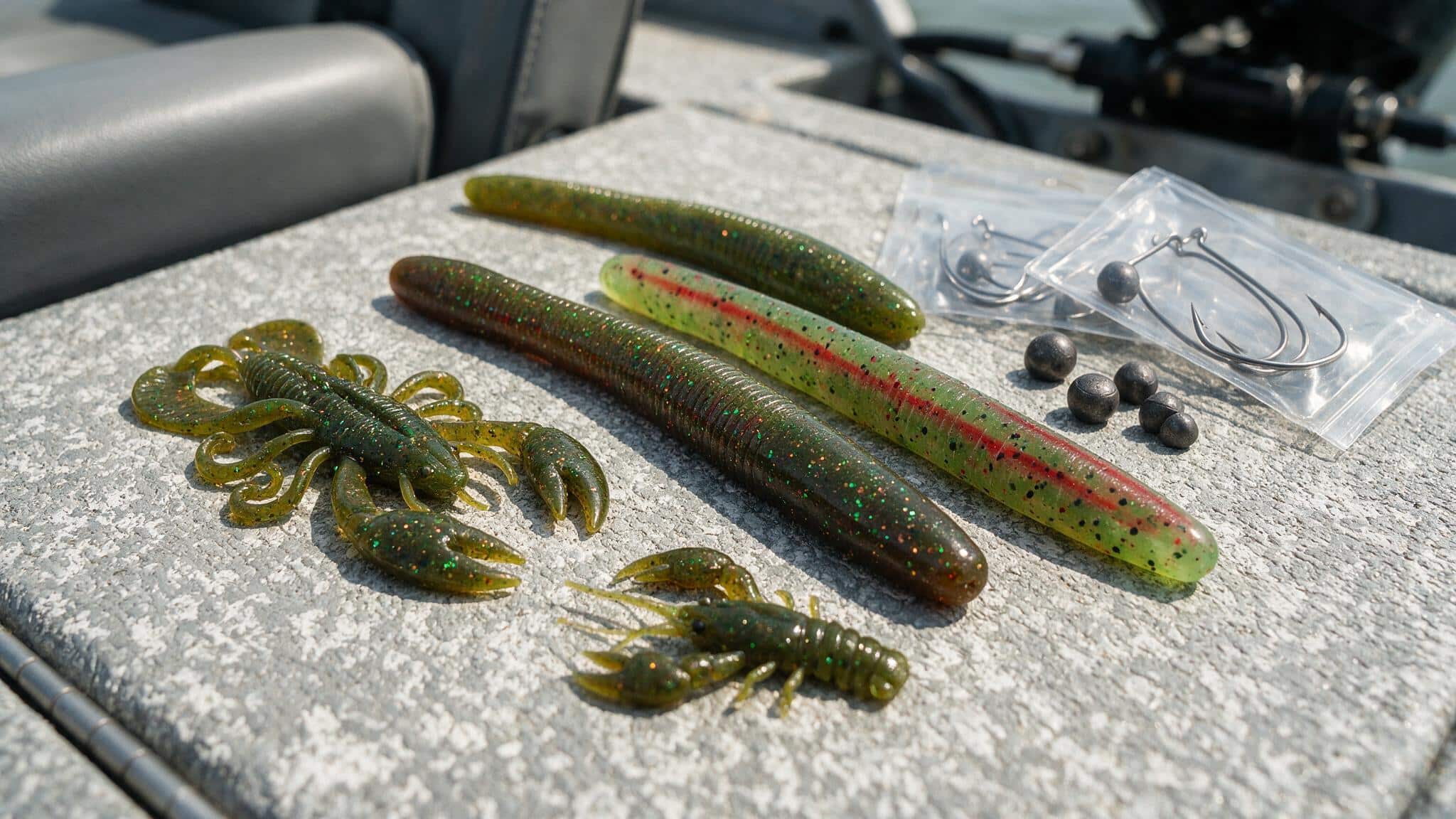
Straight tail worms are the default choice for a shaky head or a wacky rig, since the tail barely moves on its own and relies on rod movement to come alive. Ribbon tail worms add built-in action from the tail on a slower fall, which makes them a better fit for a Texas rig worked through cover where you want movement without extra rod work. Creature baits, the bulkier baits with flapping appendages, push more water and work well as a flipping and pitching bait around heavy vegetation. Craws imitate exactly what the name suggests and shine on any rig fished near the bottom, especially in rocky areas where bass key on crawfish. Stick baits, the simple cigar-shaped soft plastics popularized by the original Senko, catch fish on nothing more than a slow, natural fall, which makes them one of the easiest soft plastic baits for bass for a newer angler to fish confidently.
rigging methods and when to use each one
A Texas rig is the default for fishing soft plastics through cover, since the hook point tucks back into the body and comes through wood and grass without constantly snagging. It’s the rig I reach for first any time I’m fishing visible cover like laydowns or dock posts.
A Carolina rig separates the weight from the bait with a leader, letting the bait float naturally above bottom while the weight drags along and telegraphs bottom composition back through the rod. It covers open, featureless bottom faster than any other soft plastic presentation, which makes it useful for locating fish before committing to something slower.
A wacky rig, hooked through the middle of a stick bait, gives the most natural fall of any common rigging method, with both ends of the bait fluttering independently. It shines in clearer water and around isolated cover where a slow, subtle fall draws strikes that a Texas rig’s faster fall would miss.
A drop shot holds the bait at a fixed height above bottom while you shake the rod tip, which makes it the best option for suspended fish or heavily pressured water where bass want something that looks like it’s barely trying to escape.
hooks and weights that actually matter
Hook size should scale with bait size, not personal preference. A hook too small for the bait folds the plastic awkwardly and hurts hookup ratio, while one too large makes the bait ride unnaturally and spooks fish in clear water. Extra wide gap hooks handle bulkier creature baits and thicker worms, while a straight shank hook suits slimmer stick baits and finesse worms better.
Tungsten weights cost more than lead but transmit far more feel through the line, since tungsten is denser and the smaller profile ticks bottom with a sharper, more distinct signal. For anyone fishing soft plastic baits for bass regularly, the upgrade from lead to tungsten is one of the few gear purchases that pays for itself in bites felt rather than missed.
Pegging a weight against the bait keeps everything moving as one unit through heavy cover, useful for flipping and pitching. Leaving it unpegged lets the weight separate from the bait on the fall, giving a more natural presentation that works better in open water and around isolated targets.
color selection without overbuying
Water clarity drives color choice more than any other factor. Green pumpkin and watermelon variations cover clear to moderately stained water and imitate natural forage close enough to catch fish in most conditions. Black and blue or junebug patterns show up better in stained and muddy water, where a bold silhouette matters more than subtle realism. White or bright colors imitate baitfish and work well in stained water or low light. Three or four colors across your soft plastic lineup cover the overwhelming majority of situations, and buying beyond that mostly satisfies curiosity rather than catching more fish.
buying in bulk makes sense here
Soft plastics get destroyed faster than any hard bait in the box, torn by fish, nicked on rock, or simply worn out after repeated casts. Buying a handful of a single color is a mistake I made early on, since running out of your confidence bait mid-trip forces a switch you didn’t want to make. Buy in bulk once you’ve found colors and styles that produce, and treat soft plastics as a consumable rather than a permanent piece of tackle.
storing soft plastics without ruining them
Different soft plastics can react chemically when stored together, especially across brands, and the result is a sticky, melted mess in the bottom of a tackle bag. Keep new packages sealed until you need them, and store opened bags by brand and color rather than dumping everything into one large tub. It’s a boring habit, and an easy one to skip, but it’s saved me from opening a bag mid-trip to find half a rotation fused into something unusable right when I needed it.
rounding out a soft plastic rotation
A tight rotation covering a straight tail worm, a creature bait, a craw, and a stick bait, rigged Texas, wacky, Carolina, and on a drop shot depending on conditions, handles nearly every bass situation you’ll run into. Pair that rotation with a chatterbait for covering water fast and a few finesse presentations for tough bites, and there’s very little water left that your box can’t handle. Soft plastic baits for bass are not the flashiest thing in the box, but across a full season, they put more fish in the boat than anything else you own.