The Alabama rig is a wire umbrella frame that carries multiple swimbaits at once, built to look like a small school of baitfish instead of a single lure. It was popularized in 2011 when a largely unknown angler named Paul Elias won a Bassmaster Elite event fishing nothing else, and by the next season it had been restricted or banned in more competitive circuits than almost any lure in bass fishing history.
It still catches fish, especially suspended bass keying on schools of shad in open water, and it is legal in most states for recreational fishing even where tournaments do not allow it.
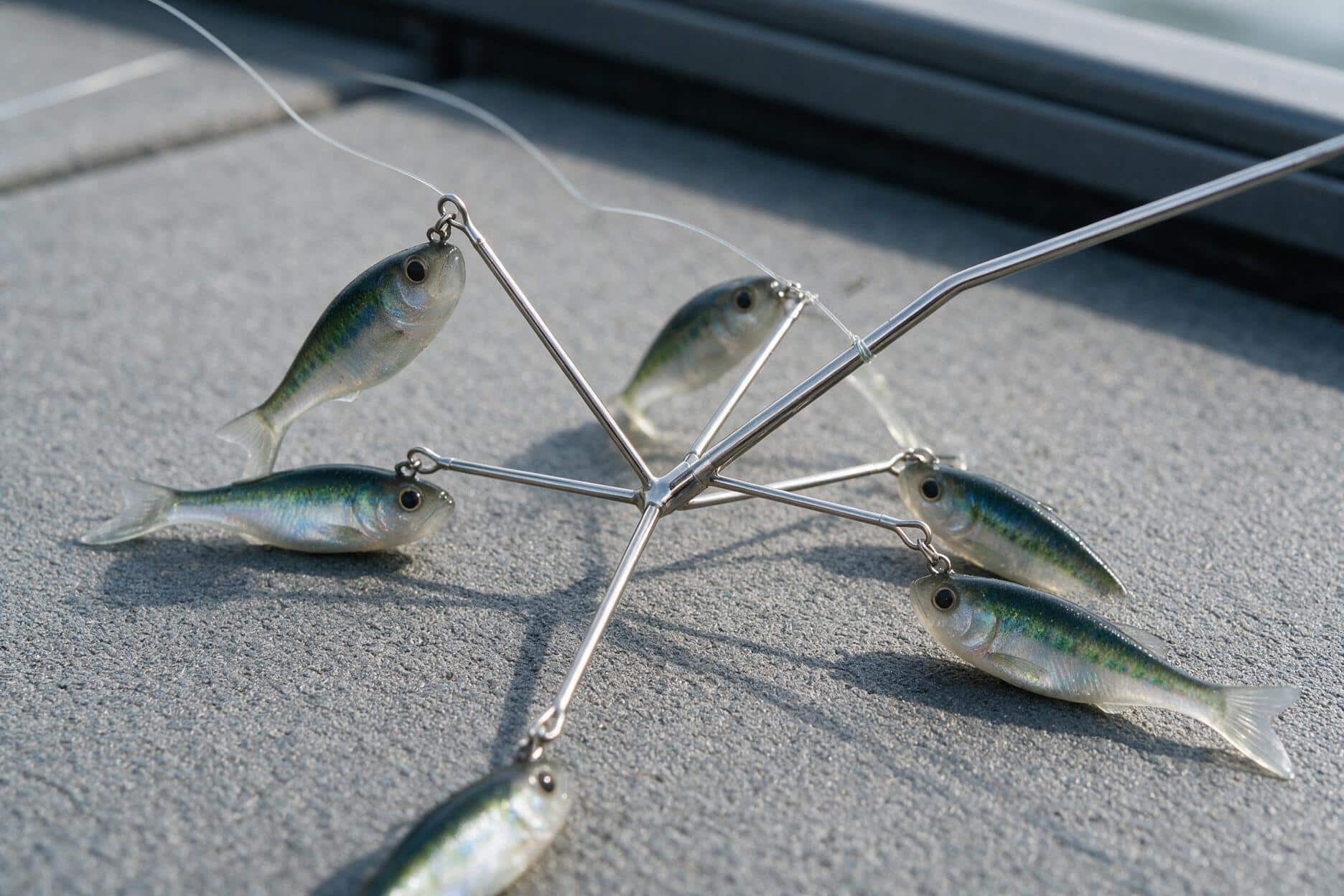
what makes up an alabama rig
A stock rig is a central wire head with 5 arms branching off it, each arm ending in a small swivel or snap. Most anglers fish it with 4 or 5 swimbaits total, though running fewer, or swapping some arms for bare wire, is legal almost everywhere and cuts down on both cost and the amount of weight you are casting.
The center arm usually carries the biggest bait, on a slightly longer leader, to look like the lead fish pulling the school. The strike is very often on the center bait, not one of the outside arms, so do not skimp on hook quality there because it is the one most likely to matter.
rigging it, wire by wire
- Attach the rig to your main line with a strong loop connection, a loop knot or a heavy-duty snap swivel, so the whole frame can swing and the arms flare naturally instead of dragging in a stiff line.
- Load swimbaits onto jig heads sized to the bait, typically 1/8 to 1/4 ounce for the outer arms and a slightly heavier head for the center bait so it tracks true at the front of the pack.
- Stagger bait sizes and colors slightly across the arms rather than running five identical swimbaits. A little variation reads as a natural school to the fish and it is easier on the eyes when you are checking the rig boatside.
- Check hook points before every cast. Five hooks means five chances to dull a point on the boat deck or a rock, and a dull hook on the center arm, the one that gets bit most, costs you more fish than a dull hook anywhere else on the rig.
fishing it: retrieve and depth
The Alabama rig is a search bait first. Cast it over open water where bass are suspended and chasing shad, count it down to the depth you want, and retrieve it with a slow, steady swim, occasionally pausing to let the whole school flutter down together. Erratic jerking works against the illusion; a real baitfish school swims in a fairly steady rhythm.
It casts heavy, five swimbaits and a wire frame add up fast, so this is not a light-rod presentation. A medium-heavy to heavy rod and 50 to 65-pound braid handle the weight and the extra water resistance of five baits swimming at once better than typical bass tackle.
where it’s legal and where it isn’t
This is the one thing to check before you tie one on, because it varies by water and by rule set, not just by state.
Most states place no restriction on umbrella rigs for general recreational fishing. The complications are mostly in tournament rules and in a handful of specific fisheries: several states cap the number of hooks per line for competitive or licensed fishing, which effectively limits an Alabama rig to fewer arms than the stock configuration, and some tournament trails, including most FLW and many club-level events, ban multi-hook umbrella rigs outright following the backlash after the 2011 win. Always check the specific water body’s regulations and, separately, the rules of any tournament you are entering. A rig that is fine for a Saturday afternoon on the lake can be an instant disqualification in a weigh-in.
common mistakes
Running five identical, heavy baits is the most common one. It looks impressive on the rod but it is exhausting to cast all day and it does not actually out-fish a well-varied, lighter setup. Start with 3 or 4 arms loaded and add more only if you are consistently missing fish to a rig that looks too sparse.
The second is fishing it too fast. This rig sells itself on looking like a school, and schools of baitfish do not sprint in a straight line for long. Slow the retrieve down more than feels natural the first few times out.
The third is skipping a swivel connection. Five swimbaits swimming at once puts a lot of twist into the line, and a rig tied on with a fixed knot instead of a swivel or loop connection will hand you a bird’s-nest of twisted line by the end of a good afternoon.
For other multi-component rigs, the Carolina rig and the drop shot rig cover single-bait presentations built for bottom contact rather than an open-water school look. All three, plus the rest of the rig types on this site, are covered together in the complete guide to fishing rigs.