The San Diego jam knot is built for braided line tied straight to a hook or lure eye, and it’s the one serious jig fishermen reach for when a Palomar feels too bulky for a small eye and a plain uni knot slips more than they’d like on smooth braid.
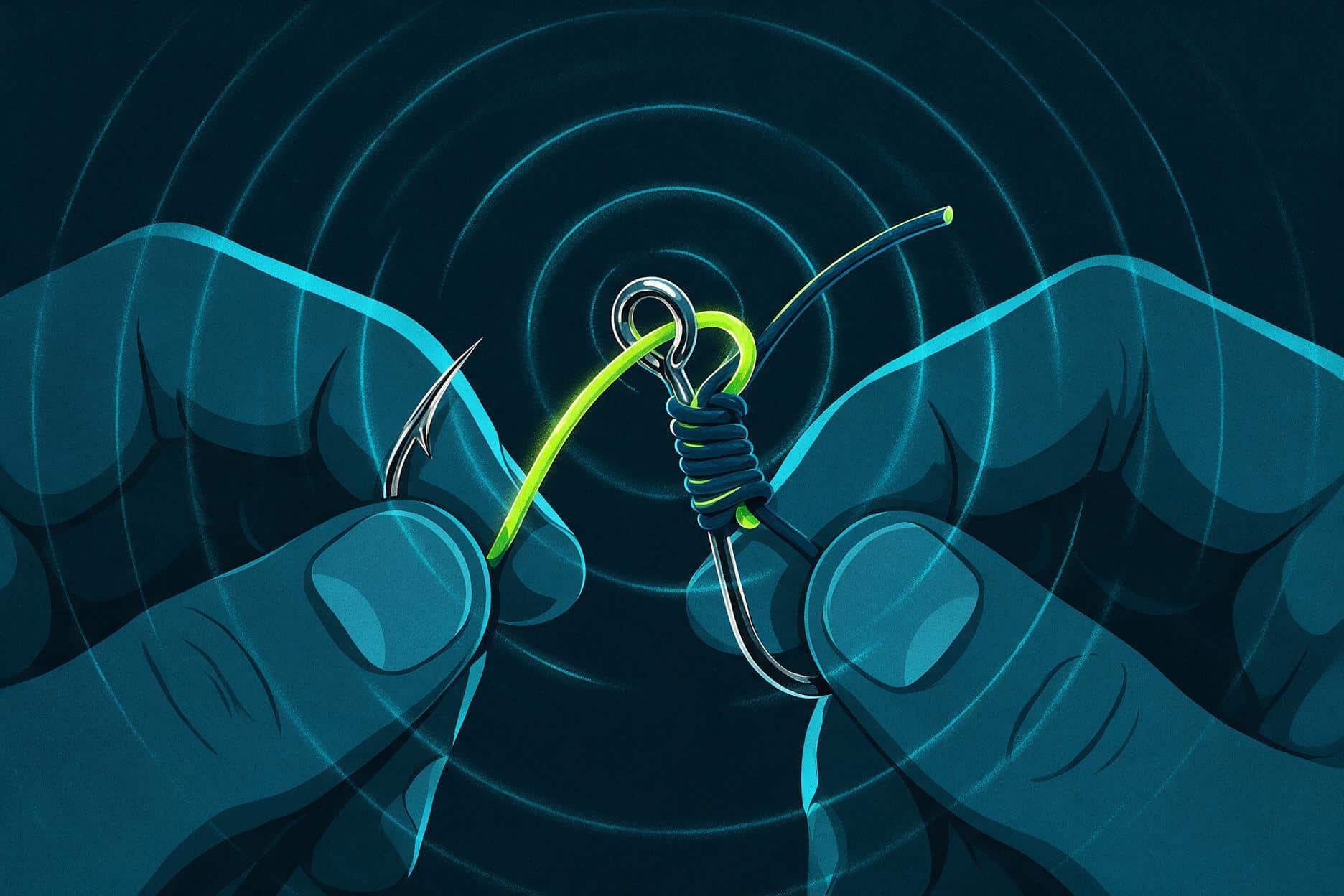
what the san diego jam knot does better
It’s built in the same family as the uni knot, wraps coiled around the standing line, but it finishes with an extra tuck that jams the coils against slipping. That matters more on braid than on mono, because braid has almost no stretch and no texture to grip itself. A knot that would hold fine on mono can work itself loose on braid after a few dozen hard jigging strokes, and the extra jam tuck is what keeps that from happening. It’s a staple on saltwater jigging rigs and offshore trolling leaders tied direct to the hook, and it’s held up for me on braid-only spinning setups fished around structure where I’m horsing fish away from cover the second they bite.
how to tie a san diego jam knot, step by step
- Run the tag end through the hook or lure eye, leaving ten to twelve inches to work with.
- Bring the tag end back alongside the standing line to form a loop running back through the eye.
- Wrap the tag end around both the standing line and the loop five to seven times, working away from the eye, the same motion as starting a uni knot.
- Thread the tag end back through the loop nearest the eye, the way you would finish a standard uni knot.
- Now add the jam: pass the tag end once more through the last coil you just wrapped, the outermost one, cinching it against itself instead of just against the loop.
- Wet the knot, pull the tag end first to snug the coils, then pull the standing line to slide the whole knot down against the eye, then finish with one firm pull on the standing line to seat it.
- Trim the tag end close.
the mistake anglers make with this knot
Skipping the jam tuck. Plenty of anglers tie the uni-knot portion, call it a San Diego jam, and never add the extra pass through the last coil. It still holds, mostly, but you’ve just tied a uni knot with extra steps and given up the exact advantage that makes this knot worth learning in the first place. If you’re not adding that last tuck through the outer coil, go tie an actual uni knot instead and save yourself the confusion.
The other mistake is reaching for this knot on mono or fluoro out of habit. It works there too, but a Palomar or a uni knot does the same job with less fuss on line that already has some grip and stretch to it. The San Diego jam earns its keep specifically on braid. Save it for that.
san diego jam versus the alternatives
A Palomar knot is still my first choice for a quick lure change when I’m not fighting slick braid on a small eye, since it’s faster to tie and just as strong. A plain uni knot is fine on mono and fluoro, or as the line-to-line double uni for joining two lengths of leader. The San Diego jam sits in a narrower lane: braid, tied direct to a hook or lure eye, where you want extra insurance against slippage. Narrow lane or not, it’s the knot on the business end of every braid spinning rod I own.
Learn this one if you fish braid straight to the hook with any regularity. It takes a few tries to get the jam tuck feeling natural, and after that it’s no slower than any other knot in the rotation. For the rest of the knots worth carrying in your head before a trip, the complete fishing knots guide lays out where this one fits against the others, and choosing the right line is worth a read if you’re still deciding between braid and mono for a given setup.
How to tie a San Diego jam knot: a uni-knot variation with an extra locking tuck, built for braided line tied direct to a hook or lure eye.
Thread and form the loop
Run the tag end through the hook or lure eye, leaving 10 to 12 inches to work with, then bring it back alongside the standing line to form a loop through the eye.
Wrap the coils
Wrap the tag end around both the standing line and the loop five to seven times, working away from the eye, the same motion as starting a uni knot.
Tie off through the loop
Thread the tag end back through the loop nearest the eye, the way you would finish a standard uni knot.
Add the jam tuck
Pass the tag end once more through the outermost coil you just wrapped, cinching it against itself instead of just the loop, the jam tuck that gives the knot its name.
Wet, cinch, and trim
Wet the knot, pull the tag end first to snug the coils, then pull the standing line to slide the whole knot down against the eye and seat it with one firm pull, then trim the tag end close.
Is the San Diego jam knot stronger than a regular uni knot?
They are close cousins, and the San Diego jam adds one extra tuck through the outermost coil that jams it against itself. On braid, that extra tuck is what keeps the coils from working loose after repeated hard hooksets or jigging strokes, something a plain uni knot can be prone to on slick, low-stretch line. On mono or fluoro, a standard uni knot already grips well enough that the difference matters less.
What line does the San Diego jam knot work best with?
Braided line tied straight to a hook or lure eye. Braid has almost no stretch or texture to grip itself, so the extra locking tuck matters there in a way it doesn’t on mono or fluorocarbon, which already have enough give and surface grip to hold a plain uni knot in place.
When should I use a Palomar knot instead of a San Diego jam knot?
For a quick lure change on an eye that isn’t fighting slick braid, a Palomar knot is still the faster tie and just as strong. Reach for the San Diego jam specifically when you’re tying braid direct to a hook or lure eye and want extra insurance against the line slipping.
What’s the most common mistake anglers make tying this knot?
Skipping the jam tuck. Plenty of anglers tie the uni-knot portion, call it a San Diego jam, and never add the extra pass through the outermost coil. It still holds, mostly, but at that point it is just a uni knot with extra steps, the jam tuck is what actually gives it the locking advantage on braid.