Walk into any tackle shop and you’ll find a wall of fishing line that all claims to be the best. Truth is, there’s no single best fishing line. There’s only the right line for what you’re doing that day, and most anglers pick line the way they pick socks: whatever’s closest, whatever they grabbed last time. That works until it doesn’t, usually right when a good fish is on.
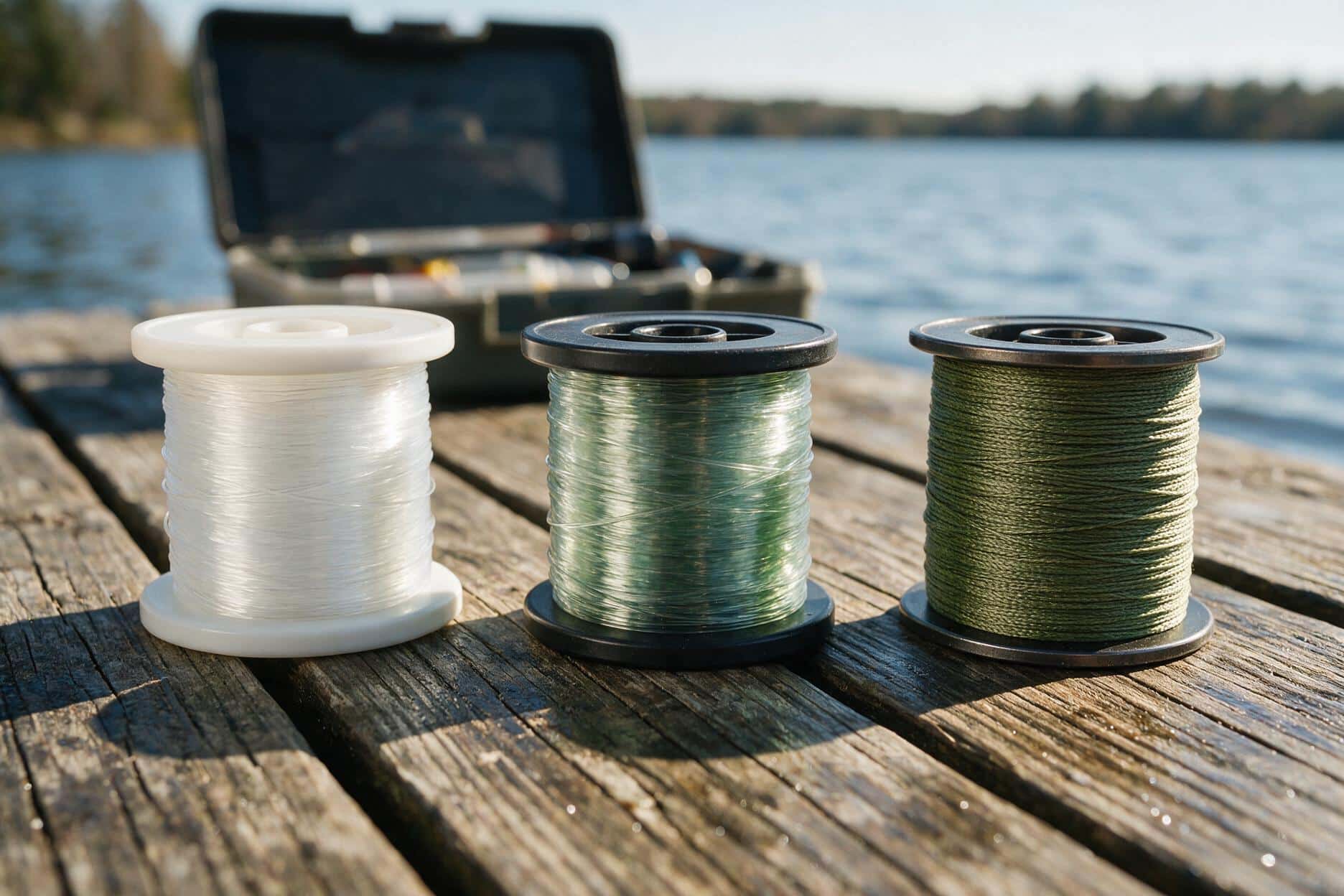
the three line types, and what they actually do differently
Everything sold as fishing line falls into one of three categories: monofilament, fluorocarbon, or braid. The differences aren’t marketing fluff, they come down to two physical properties: how much the line stretches, and how visible it is underwater. Get those two things straight and picking line stops being a guessing game.
Mono stretches the most and floats. Fluorocarbon barely stretches, sinks, and is close to invisible underwater because its refractive index is close to water’s. Braid doesn’t stretch at all, floats, and is visible, but it’s also thinner than mono or fluoro at the same strength, sometimes by a factor of four.
monofilament: still the right call more often than people think
Mono gets treated like the beginner’s line, the thing you graduate away from. That’s backwards. The stretch that makes mono forgiving on hooksets is the same stretch that keeps a fish from tearing a hook out of a soft-mouthed species like crappie or trout. If you’re throwing topwater lures, that same stretch stops you from ripping the bait away from a fish that hasn’t fully committed yet. That forgiveness matters even more with hand-poured or hand-tied baits, so if you’re getting into building your own, our lure making for beginners guide covers what to start with.
Mono is also cheap enough to respool every few months, which matters because mono degrades. UV exposure and repeated casting weaken it in ways you can’t see until it snaps on a fish you needed to land. If your mono is older than a season, replace it before you need it, not after it costs you a fish.
fluorocarbon: worth the price when visibility actually matters
Fluorocarbon costs two to three times what mono does, and in clear water or heavily pressured lakes, it earns that price back. Fish in gin-clear water key in on line the same way they key in on an unnatural retrieve. Fluoro’s near-invisibility solves a problem mono creates.
The tradeoff is stiffness. Straight fluorocarbon on a spinning reel casts worse and tangles more than mono, which is why most anglers run it as a leader tied to braid rather than filling a whole spool with it, especially on lighter spinning setups. On baitcasters, fluoro as a mainline is more common because the reel handles the stiffness better.
braided line: no stretch, thin diameter, one real weakness
Braid’s selling point is sensitivity. Zero stretch means you feel a bite the instant it happens instead of feeling it after the fish has already spit the bait. That same zero stretch means a hookset that would just move a mono line straight up rips through weeds and heavy cover, which is why braid is the standard for flipping and pitching into thick vegetation.
The weakness is visibility. Braid sits right on the surface and shows up against clear water like a dark thread. Run a fluorocarbon leader when the water calls for it, that combination gets you braid’s sensitivity with fluoro’s stealth.
picking line test for what you’re actually targeting
Line test should match the fish and the cover, not the biggest number on the spool. Panfish and trout rarely need anything past 4 to 8 pound test, going heavier just kills your bite detection and casting distance for no benefit. Bass fishing around cover typically runs 12 to 20 pound test, and flipping into matted vegetation is where anglers jump to 40 or 50 pound braid, not because the fish is bigger, but because the cover demands it.
The mistake to avoid is sizing line for the worst-case fish instead of the average one. Heavier line means less action on lures, shorter casts, and more refusals from wary fish. You lose more from oversized line spooking fish than you’d ever lose from being slightly undergunned on the rare trophy.
when you need a leader, and when you don’t
A leader is a short length of a different line type tied to your main line, usually fluorocarbon tied to braid. You need one whenever your mainline’s weakness becomes the fish’s opportunity: braid’s visibility in clear water, or its total lack of abrasion resistance against rock, shell beds, or a pike’s teeth. This exact pattern shows up in bottom rigs too, like a Carolina rig, where the leader length between weight and hook changes how the bait behaves as much as it changes stealth.
You don’t need a leader running straight mono or straight fluorocarbon in most freshwater situations. Adding one there is just adding a connection knot that can fail for no real benefit. Save the leader system for when the mainline actually has a weakness the leader fixes.
line memory is why your reel backlashes, not your technique
Line memory is the coiling a line holds after sitting on a spool, and it’s the most underrated cause of casting problems anglers blame on themselves. Cheap mono left on a reel over winter comes off in tight coils that catch on the spool lip and guides, causing backlashes and wind knots that have nothing to do with thumb control.
Braid barely holds memory, which is one more reason it casts smoother out of the box. If you’re getting backlashes you can’t explain, respool before you touch your casting technique. It’s the cheaper fix and it’s usually the right one.
common mistakes anglers make with line
The biggest one is buying line once a year and forgetting it exists after that. Line is a consumable, not a fixture. UV damage, abrasion, and knot failure from old line cost more fish than bad lures ever will.
The second is skipping the knot that matches the line type. Fluorocarbon and braid both need different knots than mono to hold full strength, tying a knot rated for mono onto braid is a common way to lose a fish to a slipped connection rather than a broken line.
fishing line FAQ
Can you mix line types on the same reel? Yes, that’s exactly what a leader is. Most experienced anglers run braid main line with a fluorocarbon leader for exactly this reason.
How often should you replace fishing line? Mono every season if you fish regularly, fluorocarbon every one to two seasons, braid can last years since it barely degrades from UV or memory.
Does higher pound test mean thicker line? Not across types. Braid at 30 pound test is often thinner than mono at 10 pound test, that’s the entire reason braid can carry more line on a smaller spool.
Can you mix line types on the same reel?
Yes, that’s exactly what a leader is. Most experienced anglers run a braid main line with a fluorocarbon leader tied on, combining braid’s sensitivity and thin diameter with fluorocarbon’s near-invisibility near the bait.
How often should you replace fishing line?
Mono every season if you fish regularly, since UV exposure and repeated casting weaken it in ways you can’t see until it fails. Fluorocarbon holds up for one to two seasons. Braid can last years, since it barely degrades from UV or line memory.
Does higher pound test mean thicker line?
Not across types. Braid at 30 pound test is often thinner than mono at 10 pound test, which is exactly why braid can carry more line on a smaller spool. Pound test tells you breaking strength, not diameter, and the two only compare directly within the same line type.
What is line memory and why does it cause backlash?
Line memory is the coiling that fishing line holds after sitting on a spool. Cheap mono left on a reel over winter comes off in tight coils that catch on the spool lip and guides, causing backlashes and wind knots that get mistaken for a casting technique problem. Braid holds almost no memory, which is one reason it casts smoother out of the box. If backlash keeps happening for no clear reason, respooling is often the cheaper and more effective fix.