Grease is not one product doing one job inside a reel, and treating it that way is how a lot of home maintenance ends up making a reel worse instead of better. Different parts need different lubricants, and using the wrong one in the wrong spot causes exactly the problems you were trying to prevent.
grease and oil are not interchangeable
Oil belongs on fast-spinning, low-friction parts: the main bearings, the handle knob bearing, the line roller on a spinning reel. These parts need something thin enough to get into tiny clearances and reduce friction without adding resistance. A drop is plenty, and more isn’t better, since excess oil just attracts dust and grit that ends up right back inside the bearing.
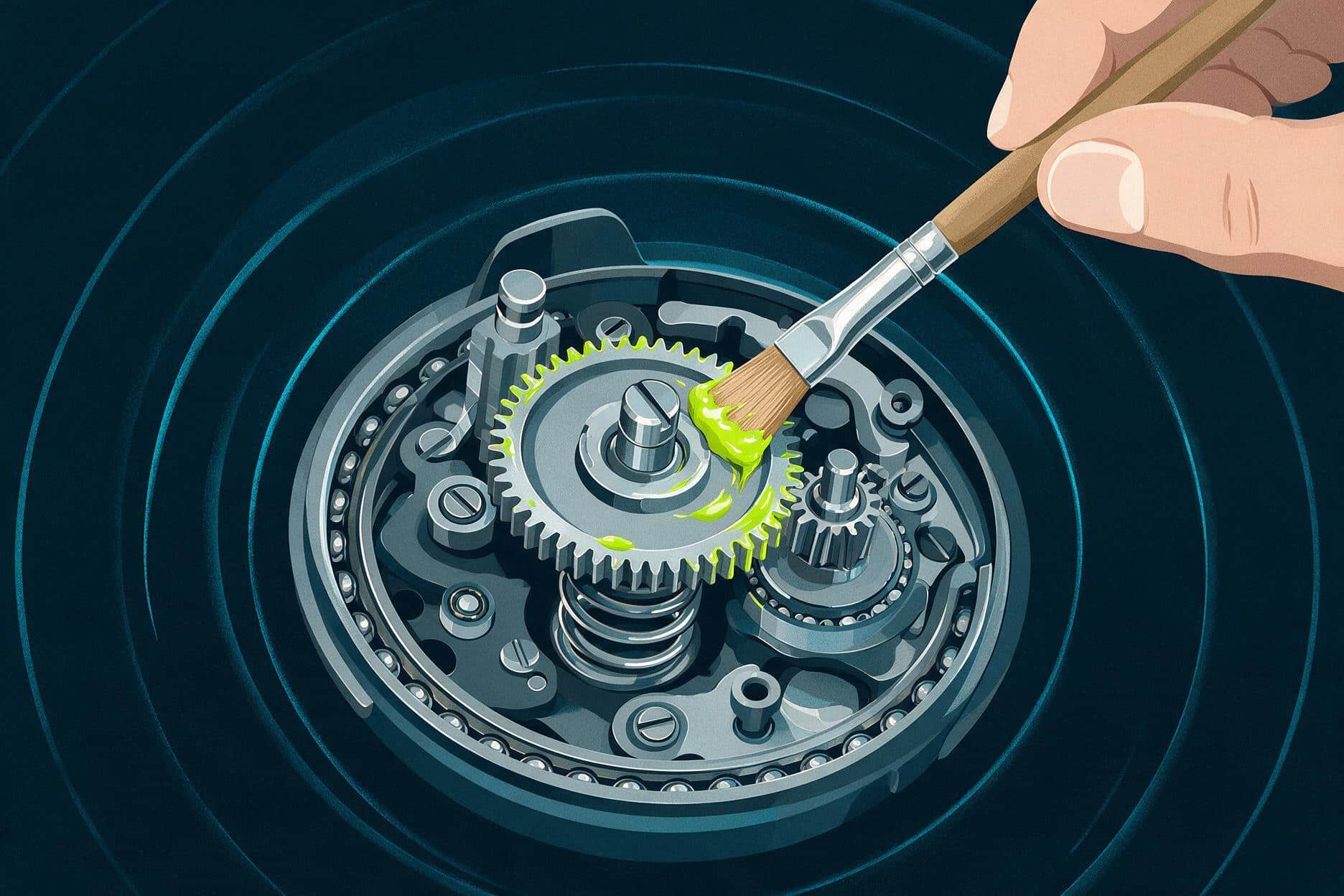
Grease belongs on parts that mesh under load: the main gear, the pinion gear, the oscillation gear that moves the spool back and forth on a spinning reel. These are metal-on-metal contact points that need a thicker film to keep from wearing down every time you turn the handle. This is also where a lot of home maintenance goes wrong, because there isn’t just one kind of grease. Gear grease is built to stay put on meshing teeth under pressure. Drag grease is a completely different formulation, built to stay smooth and consistent under the heat and friction a drag system generates when a fish is taking line. Using one in place of the other doesn’t just underperform, it actively causes new problems.
why the wrong grease on a drag stack ruins your day
Drag washers, whether felt, fiber, or carbon, need a light, specific coating that lets them slide against each other smoothly under pressure. Pack a drag stack with standard gear grease and you get a drag that grabs and releases instead of applying steady pressure, exactly the kind of jerky resistance that snaps light line on a hard run. This is one of the more common reasons a drag feels great on the bench and terrible on a fish, and it traces straight back to using the wrong tub of grease during the last service.
how often to regrease
For casual freshwater use, once a season is enough for most reels. If you’re fishing saltwater, or fishing hard several times a week, that interval shrinks to every few trips, and after any saltwater exposure specifically, regardless of how clean the reel looks on the outside. Salt crystallizes in places you can’t see and starts corroding gear surfaces well before there’s any visible sign of it, so a saltwater reel that "looks fine" on the outside can already have damage building on the inside.
how to actually apply it
A thin, even film, not a packed gear cavity. This is the mistake I see most often when someone finally opens up a reel that’s never been serviced: gears buried in grease, as if more grease means more protection. It doesn’t. Overpacking adds drag to the retrieve, can attract more grit than it repels, and makes the next service messier without adding any real benefit. Wipe old grease off, apply a thin coat with a small brush or your fingertip, and wipe away anything that looks like excess.
what to actually keep in the tackle box
Three small containers: a reel-specific gear grease, a separate drag grease, and a bottle of reel oil for bearings. That’s the complete kit, and because each application uses such a small amount, all three last years before you need to replace them. It’s a small investment against the cost of a drag that fails at the wrong moment or gears that wear out years before they should.
Reel grease is cheap and the mistakes around it are avoidable once you know which product goes where. For the rest of what keeps a reel running smoothly, the reel maintenance checklist covers the full schedule, and common reel repairs walks through what to do once something’s already gone wrong.