Most of what sends a reel to the shop is something you can fix at your own kitchen table in twenty minutes. I’ve kept reels running eight, ten years past when a lot of anglers would have traded them in, and none of it required special training, just a willingness to open the side plate and look.
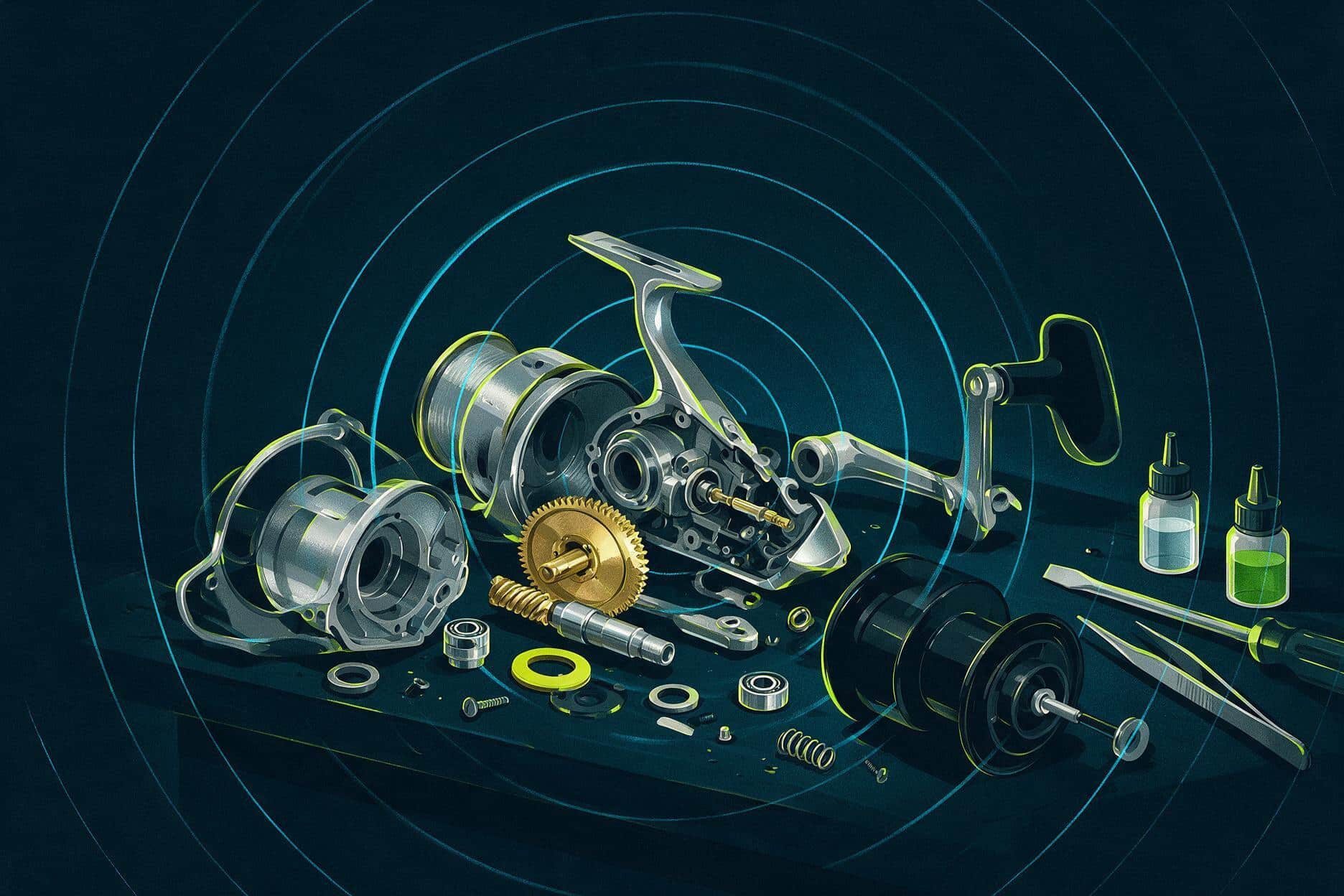
when it’s actually worth fixing yourself
An entry-level reel under fifty dollars usually isn’t worth a professional service call. The labor alone can run close to what a new one costs, so past a certain point of wear I just replace those outright. Mid-range and high-end reels are a different story. A hundred-fifty-dollar reel with a bad bearing or gunked-up drag is absolutely worth an evening of your time to fix, and most of the repairs below take less time than driving to a tackle shop and back.
common problems and how to fix them
A grinding or clicking sound during the retrieve almost always means dirty or dry bearings. Sand, dried salt, and old grease turn into grit inside the bearing races, and that grit is what you’re hearing. Pull the spool, flush the exposed bearings with reel cleaner or isopropyl alcohol, let them dry completely, then add a drop of reel oil, not grease, to each one. Grease is too thick for bearings and slows the spool down.
Drag that slips under light pressure or grabs and releases instead of applying smooth pressure usually means the drag washers are gunked up with old grease, dirt, or water that got past the seals. Pull the spool, remove the drag stack, and wipe every washer clean. Felt or fiber washers need a light coat of reel-specific grease when you reassemble them, not whatever grease happens to be in the garage. General-purpose grease can be too thick or chemically wrong for the washer material and makes drag behavior worse, not better.
A handle that wobbles or a retrieve that feels rough usually traces back to a worn handle bushing or a slightly bent handle shaft, often from a fall or getting stepped on in a boat. Check the handle for any visible bend first. If it’s straight, the bushing inside the handle knob is the more likely culprit, and it’s a cheap replacement part on most reels.
A bail on a spinning reel that won’t flip closed reliably is almost always a fatigued bail spring or a pivot pin caked with old grease and grit. Clean the pivot points first with a pick and a little alcohol, since that alone fixes a surprising number of sticky bails. If it’s still weak after cleaning, the spring itself needs replacing, which is a cheap part but a fiddly one to install the first time.
A reel that locks up completely, no rotation at all, is the one failure on this list I don’t try to push through. That’s usually a stripped or cracked main gear, or debris jammed hard enough into the gear train to shear something if you force it. Stop turning the handle the moment you feel that kind of resistance.
the basic toolkit worth owning
A small precision screwdriver set, reel oil, reel-specific grease, a handful of cotton swabs, a fine pick for cleaning grit out of tight spots, and tweezers. That’s the whole kit, and it costs less than one professional service call. I built mine years ago and it’s paid for itself many times over since.
the mistake that makes reel problems worse
Reaching for WD-40. It’s a solvent built to displace water and loosen rust, not a lubricant, and spraying it into a reel strips out the actual grease and oil that belongs there. The reel might spin freely for a day or two afterward, which is exactly what makes this mistake so common, and then it gums up worse than before as the solvent evaporates and leaves behind whatever grit it dissolved along the way. Keep it out of the tackle box entirely and use products built for reels.
when to actually send it in
A stripped main gear, a bent rotor or frame, or a saltwater reel that went fully underwater and wasn’t rinsed and opened up within a day or two are all past what I’d try to fix on my own. At that point you’re looking at parts a home toolkit doesn’t include, and a shop with the right replacement gears will do it faster and more reliably than trial and error at the kitchen table.
Most reel problems are simpler than they sound from the noise they make. Pull the side plate before you assume the worst. For the maintenance schedule that keeps you from needing most of these fixes in the first place, the reel maintenance checklist is the place to start.
Most of what sends a reel to the shop is something you can fix at your own kitchen table in twenty minutes. I’ve kept reels running eight, ten years past when a lot of anglers would have traded them in, and none of it required special training, just a willingness to open the side plate and look.
Fix grinding or clicking bearings
Pull the spool and flush the exposed bearings with reel cleaner or isopropyl alcohol. Let them dry completely, then add a drop of reel oil, not grease, to each one. Grease is too thick for bearings and slows the spool down.
Fix a slipping or grabbing drag
Pull the spool, remove the drag stack, and wipe every washer clean. Felt or fiber washers need a light coat of reel-specific grease when you reassemble them, not general-purpose grease, which can be too thick or chemically wrong for the washer material.
Fix a wobbling handle
Check the handle for any visible bend first. If it’s straight, the worn handle bushing inside the handle knob is the more likely culprit, and it’s a cheap replacement part on most reels.
Fix a bail that won’t flip closed
Clean the pivot points first with a pick and a little alcohol, since that alone fixes a surprising number of sticky bails. If the bail is still weak after cleaning, the fatigued bail spring itself needs replacing, a cheap but fiddly part to install the first time.
Is it worth fixing an entry-level reel yourself?
Usually not. An entry-level reel under fifty dollars usually isn’t worth a professional service call, since labor alone can run close to what a new one costs, so it often makes more sense to replace it outright. Mid-range and high-end reels are a different story and are worth an evening of DIY repair time.
Can I use WD-40 to fix a sticky reel?
No. WD-40 is a solvent built to displace water and loosen rust, not a lubricant, and spraying it into a reel strips out the actual grease and oil that belongs there. The reel might spin freely for a day or two afterward, which is what makes this mistake so common, then it gums up worse than before as the solvent evaporates.
When should I take a reel to a professional instead of fixing it myself?
A stripped or cracked main gear, a bent rotor or frame, or a saltwater reel that went fully underwater and wasn’t rinsed and opened up within a day or two are all past what’s worth trying at home. Those repairs need parts a home toolkit doesn’t include, and a shop with the right replacement gears will do it faster and more reliably.
What tools do I need for basic reel repair at home?
A small precision screwdriver set, reel oil, reel-specific grease, a handful of cotton swabs, a fine pick for cleaning grit out of tight spots, and tweezers. That’s the whole kit, and it costs less than one professional service call.