The Albright knot joins two lines of very different diameter, most often a heavier butt section or wire leader to a lighter running line. It shows up anywhere an angler needs to connect mismatched materials: backing to fly line, mono to wire for toothy fish, or a thick fluorocarbon leader to lighter braid on an offshore or big-swimbait setup.
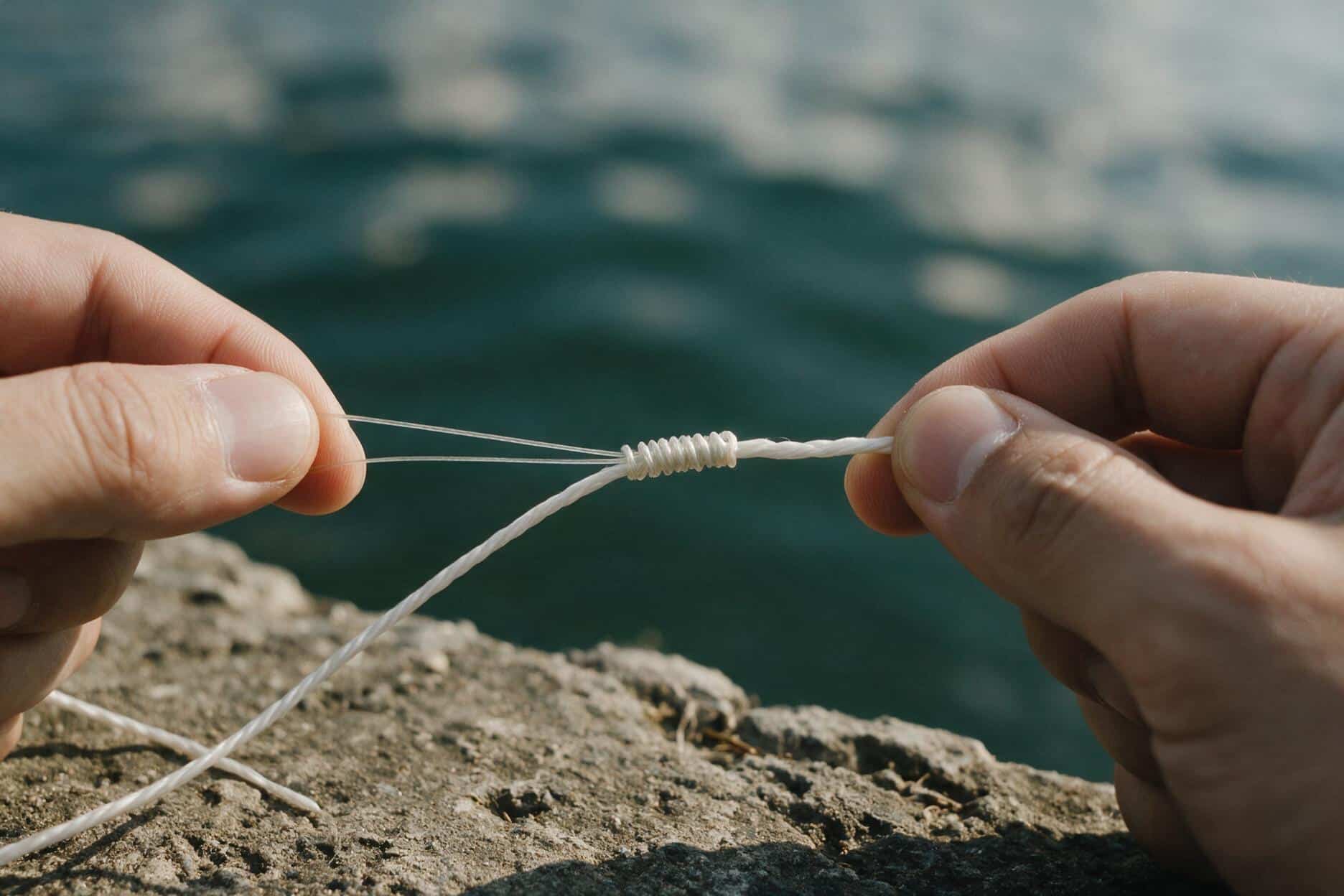
It is not a knot most bass anglers tie every trip. It earns its place on this list because when you do need to join two very different lines, most of the common line-to-line knots, uni-to-uni, blood knot, either slip or fail outright once the diameter difference gets large enough, and the Albright is one of the few that holds up.
when to reach for it
Diameter mismatch is the deciding factor. Two lines close in diameter, say 10-pound mono to 14-pound mono, tie together fine with a uni-to-uni knot or a blood knot, both faster to tie. Once the gap gets bigger, closer to double the diameter or more, like a 12-pound running line to a 40-pound shock leader, those knots start slipping under load because the thinner line has nothing to bite into. That is the situation the Albright is built for.
It also handles mono-to-wire connections, which most other line-to-line knots cannot do at all, which is why it shows up constantly in toothy-fish rigging, pike, musky, some saltwater species, even outside bass fishing.
tying the albright knot, step by step
- Form a loop in the heavier line (the leader or wire) by doubling back about 4 to 5 inches of it. Hold the loop so it stays open.
- Pass the tag end of the lighter line through the loop from one side.
- Wrap the lighter line back around both strands of the loop and around itself, working back toward the closed end of the loop. 10 to 12 wraps is standard for mono-to-mono; wire connections often need fewer, tighter wraps since wire does not compress the way mono does.
- Pass the tag end of the lighter line back through the loop, exiting the same side it entered.
- Hold both tag ends and both standing lines, and pull evenly from all four points to work the wraps down snug against the closed end of the loop. Wet the knot before the final pull on mono-to-mono connections.
- Pull hard on the standing lines, not the tag ends, to seat the knot fully, then trim both tag ends close.
The hardest part to get right by feel is keeping the wraps snug against each other as they cinch down, rather than letting them bunch up or cross over one another. Wrapping under light tension throughout, instead of loose and tightening only at the end, keeps the coils in order.
common mistakes
Too few wraps on a big diameter difference is the most common failure. The number of wraps needed scales with how different the two lines are, not a fixed count. A small mono-to-mono step gets away with 7 or 8 wraps; a mono-to-wire connection with a large jump in stiffness needs closer to 12 to seat properly.
The second is pulling only on the tag ends to set the knot. The tag ends snug the wraps, but the standing lines are what actually seats the knot under real tension. Skipping the final pull on the standing lines leaves a knot that looks finished but has not actually locked down.
The third is using it where a simpler knot would do. If the diameter difference is small, an Albright takes longer to tie for no strength advantage over a uni-to-uni connection, and more steps means more chances to get one wrong under bad light or cold hands on the water.
testing it before it matters
Pull-test any Albright knot before it goes out on the water, especially a mono-to-wire connection meant for fish with teeth. Hold the leader in one hand and the running line in the other and pull hard, well past what a normal cast puts on it. A properly wrapped knot holds; a poorly wrapped one either slips through the loop or the wraps bunch up and pop loose. Better to find that out on the dock than mid-fight.
albright vs. other line-to-line connections
For similar-diameter connections, a uni knot tied twice, once in each line and cinched together, known as a uni-to-uni knot, is faster to tie and holds just as well. Save the Albright for situations a uni-to-uni cannot handle: wire leaders, or a genuinely large step up in diameter.
This is one of several connections covered in the complete guide to fishing knots. For guidance on when a diameter step like this is even necessary, see the guide to choosing fishing line, which covers when a heavier leader is worth adding in the first place.
How to tie an Albright knot to join two lines of very different diameter, such as a heavy leader or wire to a lighter running line.
Form a loop in the heavier line
Form a loop in the heavier line (the leader or wire) by doubling back about 4 to 5 inches of it, and hold the loop so it stays open.
Pass the lighter line through the loop
Pass the tag end of the lighter line through the loop from one side.
Wrap toward the closed end
Wrap the lighter line around both strands of the loop and around itself, working back toward the closed end of the loop, about 10 to 12 wraps for mono-to-mono, fewer but tighter wraps for wire.
Exit and pull the wraps snug
Pass the tag end back through the loop on the same side it entered, then pull evenly on both tag ends and both standing lines to work the wraps snug, wetting the knot first on mono-to-mono connections.
Seat the knot and trim
Pull hard on the standing lines, not the tag ends, to fully seat the knot, then trim both tag ends close.
When should you use an Albright knot instead of a uni-to-uni knot?
Reach for the Albright when the diameter difference between the two lines is large, roughly double or more, like a 12-pound running line to a 40-pound shock leader. For lines close in diameter, a uni-to-uni knot is faster to tie and holds just as well.
Can an Albright knot join mono to wire?
Yes. The Albright is one of the few line-to-line knots that handles mono-to-wire connections, which is why it shows up constantly in pike, musky, and toothy saltwater rigging. Wire connections typically need fewer, tighter wraps than mono-to-mono since wire doesn’t compress the way mono does.
How many wraps does an Albright knot need?
It scales with how different the two lines are rather than a fixed count. A small mono-to-mono step gets by with 7 to 8 wraps, while a mono-to-wire connection with a bigger jump in stiffness needs closer to 12 to seat properly.
What’s the most common way an Albright knot fails?
Too few wraps for how different the two lines are is the most common cause. The second is pulling only on the tag ends to set the knot, when it’s actually pulling hard on the standing lines that seats it under real tension.