Ice fishing for perch is a search: schools roam flats and mud basins, so you drill, check holes briefly, and keep moving until the flasher lights up, then work a small spoon or bait-tipped jig while the school is under you.
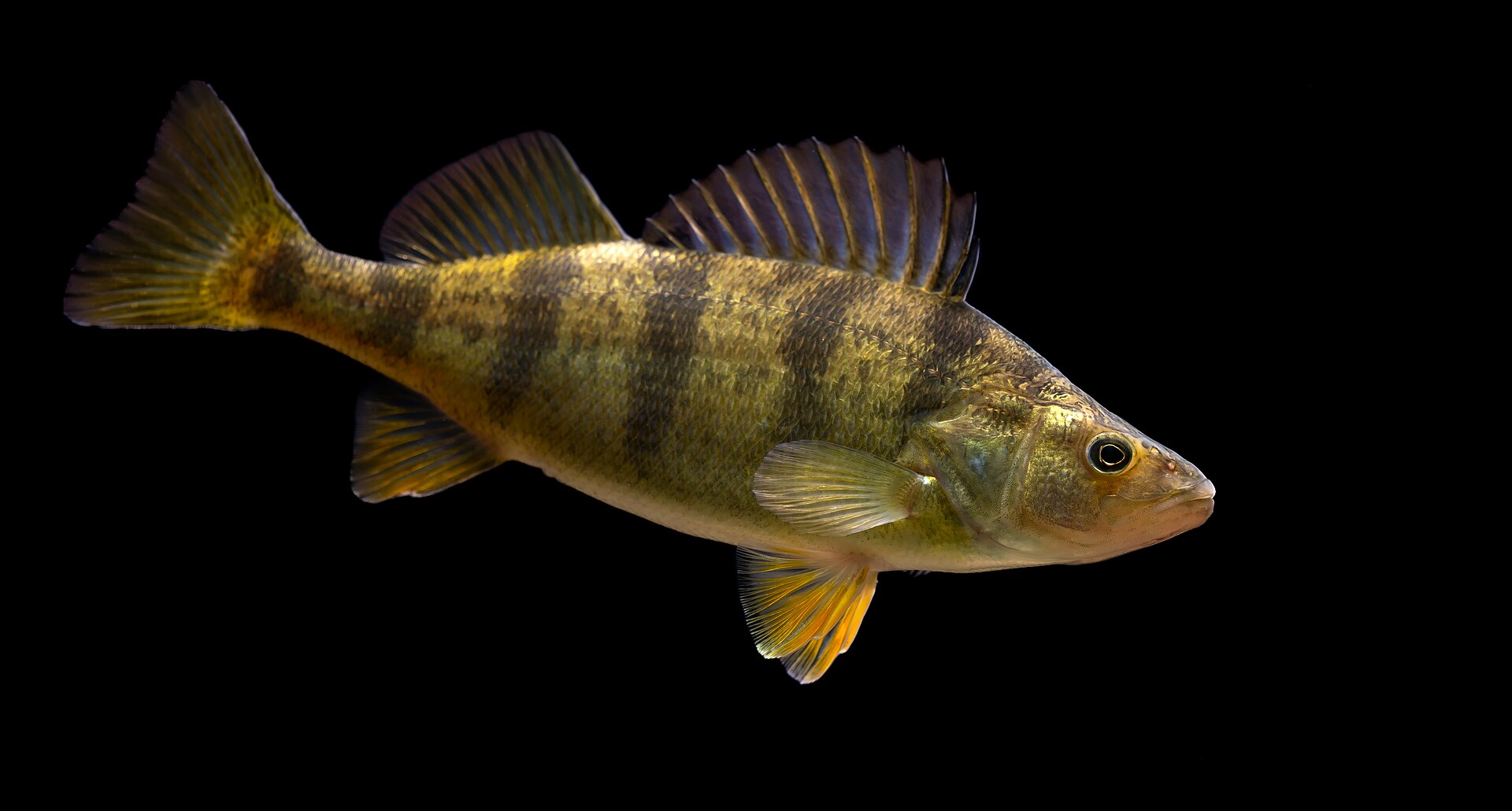
How perch behave under the ice
Yellow perch travel in schools and feed as they go, which shapes everything about how you fish for them in winter. The Iowa DNR’s yellow perch species page describes the pattern well: fishing can be slow at first, then turn fast as a school moves through while feeding. That is the rhythm to expect. A hole that was dead for ten minutes can produce a fish on every drop, then go quiet again when the school slides off.
Perch also tend to move deeper in winter. The same Iowa page says perch stay in deeper water through the cold months and are often found over large, featureless sand and silt flats in the middle of the lake. If you are used to catching them along summer weedlines, expect to spend more of your winter over open bottom. Our ice fishing gear guide covers the basic kit, and for perch the two items that matter most are a fast way to drill holes and a flasher.
Where to look: flats, mud basins and edges
“Featureless” does not mean random. In-Fisherman’s piece on patterning deep perch says perch gather where firm sand or gravel gives way to muck, and compares them to cattle that roam until they hit the edge of a basin. Its advice is to search along the basin perimeter first, where a depth change lines up with a change in bottom type, and only then move out into the open basin. Mud bottoms hold insect larvae and other small prey, which is what draws the fish there.
Depth is relative to the lake. The same article treats deep as more than 50 feet in a main-lake basin, or less than 20 feet in a shallow bay, and describes schools on one large northern lake that can be 10 to 15 feet thick. In-Fisherman’s perch article with Dave Genz adds that perch feeding on invertebrates favor flats and the transitions between soft and hard bottom. A lake map that shows those transitions saves a lot of drilling.
Drilling and moving to find a school
Because perch move, the angler who moves usually wins. In-Fisherman’s perch search article shares two versions of the same idea from experienced ice anglers. One drills 6 to 10 holes, fishes about 10 minutes, and moves. The other drills at least 15 holes in a small area and fishes each one for only 30 seconds to a couple of minutes. The Iowa DNR gives a looser rule: if there is still no action after 15 or 20 minutes, move and try again.
Drill your holes before you start fishing them, so the noise is done before you need the fish to settle. Spread the holes across the edge and out onto the flat, then fish them in a loop. Mark any hole where you see fish on the flasher, even if they did not bite, so you know where to start the next loop.
Staying on a school once you find it
Finding perch is half the job. Keeping up with them is the other half. When the bite fades, check the next few holes in the direction the fish seemed to be heading rather than packing up for a new spot across the lake. A school that left your hole may still be close by.
Keep a fast lure down to hold fish under you once a school arrives, and get each fish off the hook and your bait back down quickly. Long pauses to rebait or untangle give the school time to drift off. If your state allows a second line, a lighter jig on another rod in a nearby hole helps you notice which way the fish are moving.
Spoons, jigs and droppers for ice fishing for perch
Spoons do the searching. They get down fast and their flash calls perch in from a distance. The anglers in In-Fisherman’s search article use rattle spoons around 1/8 ounce, and up to 1/4 ounce in clear water, while the deep-perch article lists search spoons up to 1/4 ounce in gold, perch and glow finishes. Our ice fishing lures guide covers spoon styles in more detail.
When fish come in and look but do not bite, a dropper helps. One angler in the search article ties a small tungsten jig about 2 feet below a spoon on 3- to 4-pound line, shortens the dropper to about 6 inches when perch rush the spoon first, and lengthens it back to 2 feet when they turn fussy. For perch feeding on insects rather than minnows, Genz favors small #10 or #12 jigs with maggots or tiny plastics.
Tipping baits that perch want
Match the tip to what the perch are eating. The Iowa DNR says insect larvae, mainly silver wigglers or maggots, are the most widely used perch bait in natural lakes, and small minnows work year-round. Waxworms and spikes go on small jigs; a minnow head adds scent and a bit of bulk to a spoon. Genz pairs spoons with minnow heads for perch that are feeding on baitfish. Bring more than one kind, since the bite can change through the day.
Reading the flasher for perch
A flasher shows the bottom, your lure and fish in the water column, and for perch it tells you whether to stay or go. Perch often hug the bottom, so watch the bottom band itself: the deep-perch article notes that a fluttering bottom signal means fish are down there even when they do not show as separate marks. When a fish rises toward your lure, slow down or hold still and let it come. If marks show up and leave without biting, change the dropper length, size or color before you change holes. If nothing shows at all, move.
Mistakes that cost perch through the ice
The biggest one is sitting on a dead hole for an hour because it produced last weekend. Perch schools move, and the angler who checks more holes finds more of them. Fishing only the summer weedline in midwinter is another, when the fish have moved to the flats and basin edges. Running one lure all day wastes the edge a spoon and dropper combo gives you. Finally, letting a school leave while you rebait or fumble with fish costs the fast stretch that makes a perch day.
Perch reward anglers who treat the lake like a grid: drill a line of holes along the basin edge, check them quickly, and stay with a school once you find it. They also share winter water with other species you can target the same way, and our crappie ice fishing guide covers the suspended panfish you are likely to meet on the same lakes.